
How to get a volleyball scholarship in the USA: indoor and beach
US colleges field more than 1,800 volleyball teams, before you even count beach. Here is where the scholarships are, what coaches look for and when to start.
The NextLane team
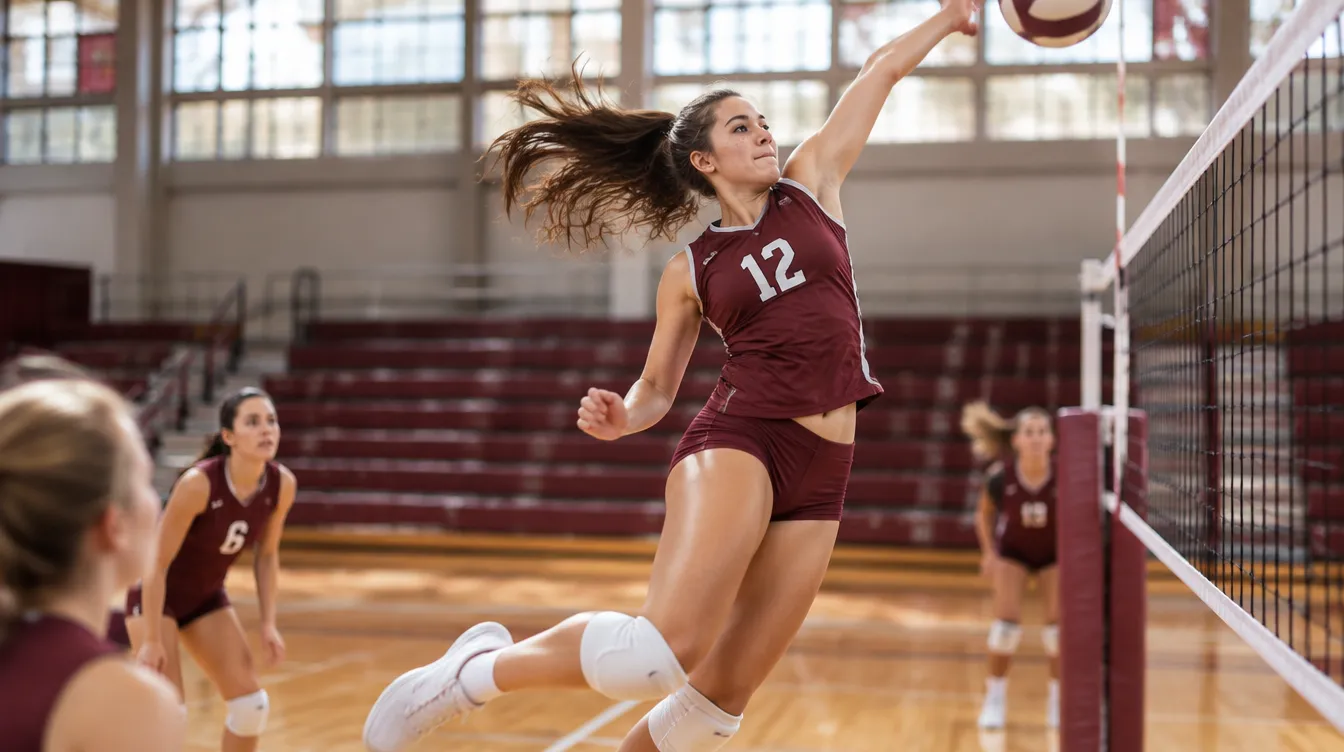
Volleyball is one of the best sports for getting a college scholarship in the USA, especially for women. There are more than 1,800 college volleyball teams, and that is before you count beach volleyball. This guide is for high school players, and their parents, who want to know how to get a volleyball scholarship step by step: where the scholarships are, what coaches look at, how beach volleyball fits in and when to start.
Where the volleyball scholarships are
| Level | Women's indoor teams | Men's indoor teams | Athletic scholarships |
|---|---|---|---|
| NCAA Division I | ~345 | ~30 | Full and partial |
| NCAA Division II | ~290 | ~40 | Full and partial |
| NAIA | ~210 | ~65 | Full and partial |
| NJCAA (two-year colleges) | ~345 | ~20 | Full and partial |
| NCAA Division III | ~420 | ~130 | None, academic aid only |
Rounded figures for the 2024-25 academic year.
The table explains the whole market. Women's indoor volleyball is huge: more than a thousand teams that can offer athletic aid. Men's volleyball is small, and most men's teams are in Division III and the NAIA. A male player can absolutely get a scholarship, but the shortlist is shorter and the competition for each spot is harder.
How many scholarships a team has depends on the conference and the school. Since 2025-26, Division I schools that moved to the new model have roster limits instead of scholarship limits and may fund every player. Elsewhere, awards are often split, and partial athletic aid is regularly topped up with academic aid.
Beach volleyball scholarships
Beach volleyball is a separate college sport with separate teams. In the NCAA it is a women's sport only, played in the spring, with around a hundred programmes, most of them in Division I. All divisions compete for one national title.
What this means for you:
- Beach rosters often include indoor players. Many athletes play indoor in the fall and beach in the spring. If you play both, tell coaches: it makes you more useful to the programme.
- Pure beach players can be recruited too, especially those with national or international junior results in pairs.
- The climate matters. The strongest beach programmes are in California, Florida, Texas, Arizona and the South.
- There are no men's college beach teams with scholarships. Men who play beach in Europe usually go the indoor route.
What volleyball coaches look for
Every coach asks the same four questions, in roughly this order.
1. Can she or he play at our level? Coaches answer this from video first. Send one or two full sets or matches plus a short highlight reel of your position: attacking, blocking, serve receive, setting or defence. Put your best clips in the first 30 seconds. Film from behind the baseline, high enough to see the whole court.
2. Do the measurements fit the position? For outside hitters, opposites and middles, coaches check height, standing reach, approach jump and block jump. Measure them accurately and put them in your profile. A setter or libero is judged more on ball control, decision-making and speed.
3. What level does the player compete at? Your club, the national youth championship, youth league, regional or national team call-ups. A coach needs to understand who you play against and your role on the team. Stats help, but the context matters more.
4. Will the player be admitted and stay eligible? That means school grades, an English test such as TOEFL or Duolingo, and for the NCAA, registration with the Eligibility Center.
Amateur status: a common question in volleyball
Many young players are registered with a club that also has a professional senior team, or have played a few matches for that senior team. This does not automatically rule you out. The NCAA reviews each case individually: what it looks at is whether you signed a contract or were paid beyond your actual expenses. There is no blanket ban, but sort out your club history and paperwork before you start writing to coaches.
Volleyball scholarships for high school students: the timeline
Volleyball rosters in the US are planned well in advance, so the earlier you start, the more choice you have.
About two years before college (age 15–16). Get an honest view of your level and the realistic leagues. Start filming every important match. Work on English and keep your grades up, because they count from the start of high school.
12–18 months before. Build your profile and video, take your English test, register with the NCAA Eligibility Center if you are aiming at Division I or II, and start contacting coaches with a short personal email, your video and your measurements.
6–12 months before. Video calls with coaches, comparing offers by the real cost after aid, signing, and the F-1 student visa.
Starting later is possible. NAIA and NJCAA teams often fill their rosters closer to the season. But fewer spots remain.
Mistakes we see most often
- Writing only to famous Division I programmes. A strong Division II, NAIA or NJCAA team where you play every match is often a better start and a better offer.
- A video without context. Clips with no indication of your jersey number, position or the level of the match.
- Missing measurements, or measurements that do not match the video.
- Ignoring the cost. A scholarship that covers half of a very expensive college can still cost more than a smaller offer at an affordable one.
- Forgetting about beach. Women who can play both indoor and beach have more options than they think.
How NextLane helps
We guide an athlete through the whole path, from the first assessment to the move to the USA:
- An honest assessment of your level. We look at your video, measurements and level of competition and tell you honestly which teams are realistic.
- Colleges that fit your goals. We shortlist schools across Division I, Division II, the NAIA and the NJCAA by your athletic level, but also by your academic goals, your family's budget and what you want to achieve in four years.
- Choosing a major. We help you decide on a field of study and check that it is offered at the colleges on your list.
- Video for coaches. We help you film and edit a reel that shows a coach your game in the first few seconds.
- We handle all communication with coaches. We write to coaches, prepare you for calls, advise you on what to say and how, and negotiate to get the largest scholarship possible.
- Comparing offers. We work out what your family will actually pay for each option, after athletic and academic aid.
- Every admission question. Documents and translations, the English test, the NCAA Eligibility Center, the F-1 student visa: we help at every step.
- All the way to the move. We stay with you until you arrive on campus.
Our founders went through US college sport themselves. We work with athletes from Russia, Kazakhstan, Kyrgyzstan and the rest of the CIS, as well as from Europe.
To find out where you could play, apply here for a free assessment. For more on the leagues and what coaches look for, see our volleyball scholarships in the USA page. If you are still comparing leagues, start with NCAA vs NAIA vs NJCAA.
FAQ
Yes, but there are far fewer men’s teams than women’s, and most of them play in NCAA Division III and the NAIA. Division III offers no athletic scholarships, so a male player’s real list is Division I, Division II, the NAIA and a few NJCAA colleges.
Yes. In the NCAA, beach volleyball is a women’s spring sport with around a hundred programmes, most in Division I. Many athletes play indoor in the fall and beach in the spring, which makes them more valuable to a programme.
There is no fixed cutoff. For hitters and blockers, coaches look at height, reach and jump; setters and liberos are judged more on ball control and decision-making. What matters is that the measurements in your profile are accurate and match your video.
Ideally about two years before college, around age 15 or 16. Starting later is possible, especially in the NAIA and NJCAA, where rosters fill closer to the season, but fewer spots remain.
Ready to take the first step?
We will go through your situation for free: sport, level and the real admission options.