
Swimming scholarships in the USA: how coaches read your times
In swimming your times say almost everything, so a strong international swimmer can earn a scholarship without a tryout. Here is how coaches read your results.
The NextLane team
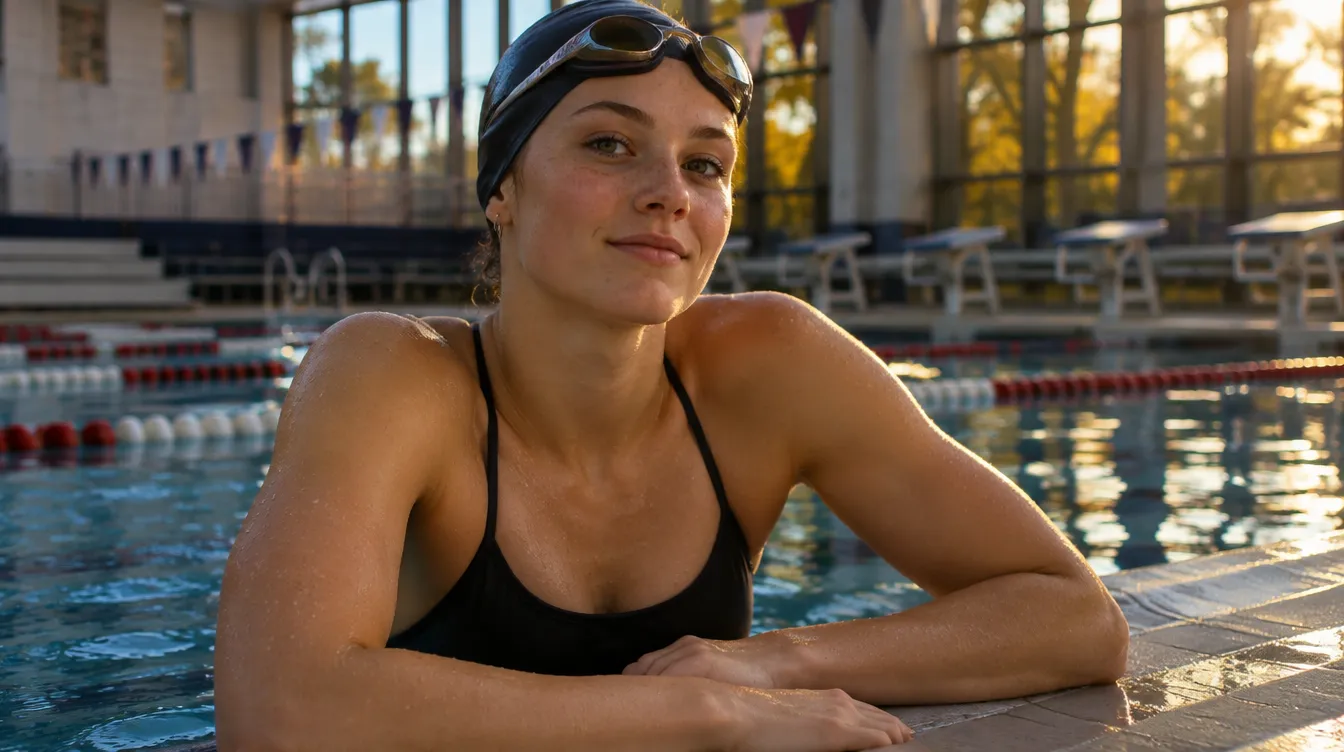
Swimming is one of the most transparent sports for getting a scholarship in the USA. A coach does not need to watch you play to know your level: your times say most of it. That is good news for international swimmers, because a strong swimmer from Europe or the CIS can earn a scholarship without ever flying over for a tryout. This guide explains how swimming scholarships work for international students, how coaches read your times and how to build a realistic list of colleges.
Where the swimming scholarships are
| Level | Men's teams | Women's teams | Athletic scholarships |
|---|---|---|---|
| NCAA Division I | ~135 | ~200 | Full and partial |
| NCAA Division II | ~75 | ~95 | Full and partial |
| NAIA | ~35 | ~35 | Full and partial |
| NJCAA (two-year colleges) | ~10 | ~10 | Full and partial |
| NCAA Division III | ~230 | ~250 | None, academic aid only |
Rounded figures for the 2024-25 academic year; the NJCAA count is especially approximate.
In US college sport, swimming and diving form one team. Divers compete at the same meets and score for the same team total. Women's teams clearly outnumber men's, so women have noticeably more options.
How many scholarships a team has depends on the conference and the school. Since 2025-26, Division I schools that adopted the new model use roster limits instead of scholarship limits and may fund every swimmer. In practice, budgets vary, and swimming awards are usually split across the roster: full scholarships go to the swimmers who score the most points, and many others receive partial awards topped up with academic aid.
How coaches read your times
Everything is converted to yards
US college swimming is raced in a 25-yard pool, known as short course yards (SCY). Your best times from 50-metre and 25-metre pools will be converted to yards before a coach compares them with anything. You can use an online conversion calculator to get an idea, but remember that conversions are approximate, and coaches know it.
Coaches compare you with their conference, not with the world
The key question for a coach is simple: how many points would this swimmer score for us at the conference championship? Each team's season builds up to its conference meet in February. If your converted time would make the A final (top 8) or B final (9–16) in an event, you score points, and that is what scholarships are paid for.
That gives you a practical way to check your level:
- Convert your best times to yards.
- Find the most recent results of the conference championship for a team you are interested in. They are published on the conference and college athletics websites.
- See where your times would place. A final means you are a strong recruit for that team. B final means you are a realistic recruit. Outside the top 16, the team is a stretch.
- Do the same for conferences at different levels: Division I, Division II, the NAIA.
Progression and range matter as much as one best time
Coaches look at how your times have moved over the last two or three years. A swimmer who is still dropping time is worth more than one whose best results were three years ago. They also value range: a swimmer who can score in two or three events and swim on relays is more useful to a team than a one-event specialist.
Video
Coaches often ask for race video to look at your technique, starts, turns and underwater work, and to judge your potential. Video also helps a coach confirm that your results are genuine, which matters for meets they do not know well.
For divers
A diving coach looks at your dive list, the degree of difficulty (DD), your meet scores and video of each dive. A difficult list that you perform consistently matters more than a couple of excellent attempts. Diving rosters are small, so a good diver can stand out quickly.
Swimming scholarships for international students: what else you need
- Academics. Solid school grades and an English test such as TOEFL or Duolingo. Good grades unlock academic aid, which often closes the gap left by a partial athletic scholarship.
- NCAA Eligibility Center. For Divisions I and II, you register there to confirm your academics and amateur status.
- Amateur status. Some swimmers receive stipends from clubs or federations. The NCAA reviews each case individually: what it looks at is whether there was a contract or payments beyond actual expenses. There is no blanket ban, but sort out your history before contacting coaches.
- Age. For athletes entering NCAA Division I or II from fall 2027, the eligibility clock starts at enrolment or the academic year after the 19th birthday, whichever comes first.
What the season looks like
The college season runs from September to March. Dual meets against other universities happen through the fall and winter, the conference championship is in February, and the national championships follow in March for swimmers who reach the qualifying standards. Training usually means morning and afternoon sessions several days a week, plus weights, all fitted around a full class schedule.
Our athlete Nina from Russia swims for Southern Illinois University in NCAA Division I with tuition, housing and meals fully covered. Her story is on our success stories page.
When to start
About two years before college is ideal. Coaches need to see your progression, and the strongest Division I programmes plan their recruiting classes early. In the final year, keep racing: a time drop in your last season can still change your offers.
How NextLane helps
We guide an athlete through the whole path, from the first assessment to the move to the USA:
- An honest assessment of your level. We convert your times to yards and compare them with real conference results to see where you would score points.
- Colleges that fit your goals. We shortlist schools across Division I, Division II, the NAIA and the NJCAA by your athletic level, but also by your academic goals, your family's budget and what you want to achieve in four years.
- Choosing a major. We help you decide on a field of study and check that it is offered at the colleges on your list.
- We handle all communication with coaches. We write to coaches, prepare you for calls, advise you on what to say and how, and negotiate to get the largest scholarship possible.
- Comparing offers. We work out what your family will actually pay for each option, after athletic and academic aid.
- Every admission question. Documents and translations, the English test, the NCAA Eligibility Center, the F-1 student visa: we help at every step.
- All the way to the move. We stay with you until you arrive on campus.
Our founders went through US college sport themselves. We work with athletes from Russia, Kazakhstan, Kyrgyzstan and the rest of the CIS, as well as from Europe.
Want to know where your times could take you? Apply here for a free assessment. For more on the teams and what coaches look for, see our swimming scholarships in the USA page; for the full process, read how to get an athletic scholarship in the USA.
FAQ
Usually not. Swimming coaches judge you on your times, your progression and race video. Many international swimmers first see their college pool after signing the scholarship agreement.
Convert your best times to yards and compare them with the latest conference championship results for the team. Making the A final (top 8) means you are a strong recruit; the B final (9–16) means you are a realistic one.
Yes, usually for the swimmers who score the most points. Swimming awards are often split across the roster, and many swimmers receive partial athletic aid topped up with academic aid.
Yes. Swimming and diving are one team in US college sport. A diving coach looks at your dive list, degree of difficulty, meet scores and video of each dive.
Ready to take the first step?
We will go through your situation for free: sport, level and the real admission options.